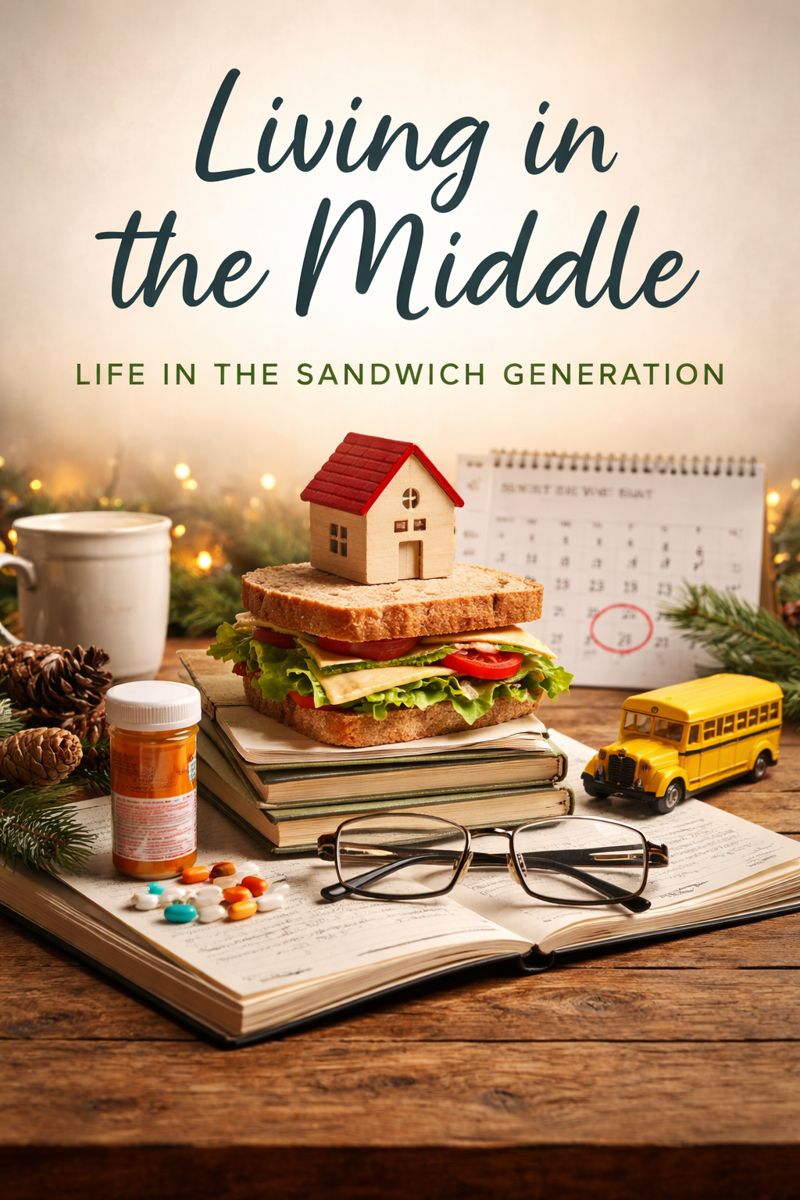
My husband and I find ourselves squarely in the sandwich generation.
Our kids still very much rely on us. We still take care of them—emotionally, financially, logistically. And now, almost without warning, our parents are beginning to need more from us as well, as their health shifts and life quietly changes shape.
Yesterday, with just six days until Christmas, that reality came into sharp focus.
My mother-in-law landed in the emergency room with an initial diagnosis of pneumonia. She had been staying at her daughter’s house, set to care for their dog while they headed overseas for the holidays. Instead, on the very day they were supposed to leave, they took her to urgent care—only to have her immediately transferred to the ER at the local hospital.
And just like that, everything was set in motion.
Phone calls. Decisions. Logistics. A mad dash to figure out care for my mother-in-law while one daughter and her family were preparing to fly out of the country, trying to get my father-in-law on an earlier flight, and coordinating which siblings could step in—and when—to provide support.
Thankfully, my husband has several siblings, and none of them hesitate to show up when their parents need help. One sister, who is retired, was able to jump in right away. But that also meant my husband would be next in line—since the other brother was sick—which meant he would be gone for Christmas.
In nearly twenty years of marriage, we’ve never spent Christmas apart. I won’t pretend that I didn’t struggle with that reality. I did. Quietly. Internally. But there was never any doubt about what needed to happen.
Without hesitation, he was going to go.
And this is where the sandwich really enters the picture.
He desperately wanted to be there for his mom—to care for her, to support his dad, to do what families do when things get hard. And at the very same time, he desperately wanted to be home with us for Christmas.
Two deep pulls. Two equally important roles. One challenging choice.
That’s the sandwich.
This is what midlife looks like for so many of us.
It’s not a crisis. It’s not a dramatic unraveling. It’s a slow realization that the roles we’ve been holding for decades are no longer neatly separated. We are still parenting forward while simultaneously caregiving backward, often without a pause to catch our breath in between.
Midlife is realizing that the safety net we once assumed would always be there is now something we are helping to hold. It’s understanding that our time, our energy, and our hearts are being pulled in opposite directions—and that there is no perfect way to do this well.
The sandwich generation isn’t just about being busy. It’s an emotional balancing act. One minute you’re coordinating hospital updates and flight changes; the next you’re wrapping presents, making grocery lists, and trying to preserve the magic of a holiday for your kids. You are needed everywhere, all at once.
And yet, there is something deeply meaningful in this season of life.
Midlife asks us to stretch—not because we want to, but because we are capable. It reveals the depth of our commitments, the strength of our partnerships, and the love that anchors us when things feel impossibly heavy. It teaches us that showing up doesn’t always look the way we imagined—but it still matters.
This is the middle. And while it can feel uncomfortable, tender, and deeply exhausting, it is also proof of a life built on connection, responsibility, and love.
And maybe that’s the real heart of midlife: not choosing one side of the sandwich over the other—but learning how to hold both.